


Act Fast. The First 5 Minutes Matter Most
When your phone hits water, the clock starts immediately. Liquid reaches internal components within seconds and begins corroding the connections that keep your phone working. What you do (and don’t do) in the first few minutes determines whether the phone is salvageable.
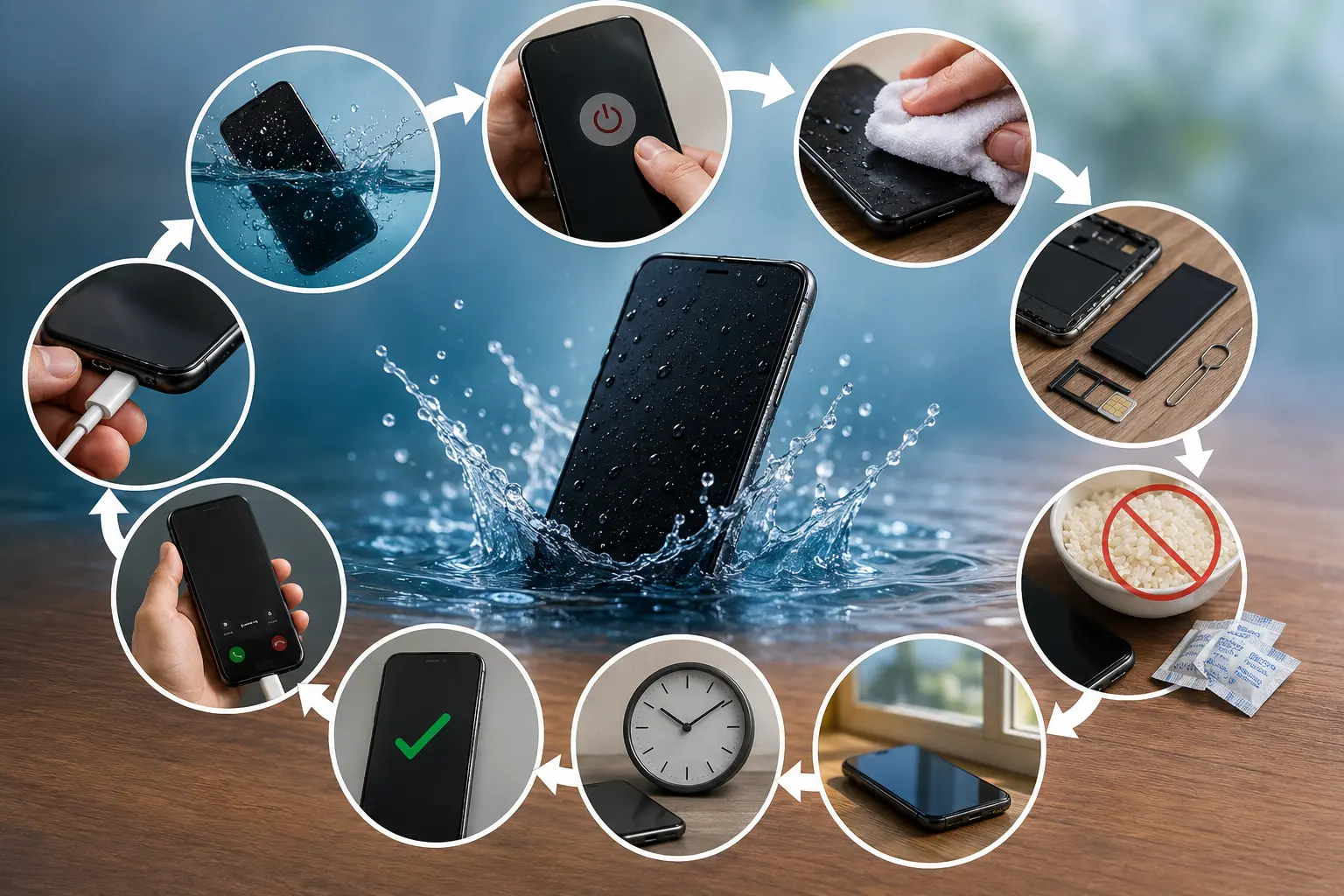
Step 1: Get It Out Immediately
Whether it fell in a sink, pool, toilet, or puddle, grab it out as fast as you can. Every additional second submerged increases the damage.
Step 2: Turn It Off
If the phone is still on, power it down right away. Do not try to use the phone to check if it still works. Running electricity through wet circuits causes short circuits that can turn a recoverable situation into a dead phone.
Step 3: Dry the Outside
Use a lint-free cloth or paper towel to wipe all visible moisture from the phone’s surface. Pay attention to the charging port, speaker grilles, and SIM card tray. Shake the phone gently (speaker-side down) to let gravity pull water out of the ports.
Step 4: Remove What You Can
Pop out the SIM card tray using the ejector pin (or a paperclip). Remove any case. If your phone has a removable battery, take it out. The goal is to open up as many gaps as possible for moisture to escape.
Step 5: Do NOT Put It in Rice
Rice does not actively absorb moisture from inside a sealed device. What it can do is push starch dust and small particles into your charging port and speaker grilles, creating additional problems.
Place the phone in a dry, well-ventilated area instead. If you have silica gel packets (the small “DO NOT EAT” packets from shoe boxes), place those around the phone. They absorb moisture far more effectively.
Step 6: Wait Before Turning It On
Leave the phone off for at least 24 hours, ideally 48 hours. Powering it on before the internal moisture has evaporated risks a short circuit that can cause permanent board-level damage.
Step 7: Test Carefully
After 24 to 48 hours, try powering the phone on. Check speaker audio, charging, camera (front and rear), touchscreen response, and connectivity. Monitor the phone over the next few days for delayed symptoms (random restarts, distorted audio, ghost touches).
Step 8: If It Doesn’t Work Normally
If the phone won’t power on, won’t charge, or shows any of the symptoms above, internal corrosion has already started. At this point, the phone needs professional repair.
What Professional Water Damage Repair Involves
Water damage repair is not just “drying the phone out.” It’s a multi-step process that requires specialized equipment.
Disassembly and Inspection
The technician opens the phone, removes the battery, display, cameras, and all other connected components. Every connector, flex cable, and the logic board are inspected under magnification for signs of corrosion, mineral deposits, or liquid residue.
Ultrasonic Cleaning
The logic board (and other affected components) are placed in an ultrasonic cleaning bath with isopropyl alcohol or a specialized electronics cleaning solution. The ultrasonic waves create microscopic cavitation bubbles that scrub corrosion and contaminants from areas that can’t be reached manually, including under chip packages and between tightly spaced solder joints.
This step is what separates professional repair from home remedies. No amount of rice, air drying, or surface wiping can clean corrosion from under a BGA chip.
Component-Level Diagnosis
After cleaning, the technician tests the board for shorted or damaged components. Water damage doesn’t always kill the entire board. Often, one or two specific ICs (charging IC, backlight IC, audio IC) have failed while the rest of the board is fine. These individual chips can be replaced through micro soldering.
Reassembly and Testing
Once the board is clean and any failed components are replaced, the phone is reassembled and tested: charging, display, touch, cellular, Wi-Fi, cameras, speakers, microphones, and sensors. If everything checks out, the phone is returned to the customer.
Success Rates
Recovery odds depend on three factors: how long the phone was submerged, whether it was powered off quickly, and what type of liquid it was exposed to. Brief exposure to clean water with the phone powered off quickly has the highest recovery rate. Extended submersion in salt water, coffee, or soda has the lowest, because these liquids leave behind corrosive residues that continue damaging components even after the phone dries.
The sooner the phone reaches a repair shop after water exposure, the better the odds. Corrosion starts within hours and spreads quickly. For more on whether professional repair makes financial sense for your specific situation, our guide on whether it’s worth repairing water damage breaks down the decision.
Water Damage Repair in Albuquerque
At our shop, we handle water damage on iPhones, Samsung Galaxy phones, and other devices. We open the phone, clean the board ultrasonically, and assess the damage before quoting a repair. There’s no charge for the diagnostic.
If you’re in Albuquerque and just dropped your phone in water, call us right away or walk in during business hours. Time is the biggest factor in water damage recovery.