


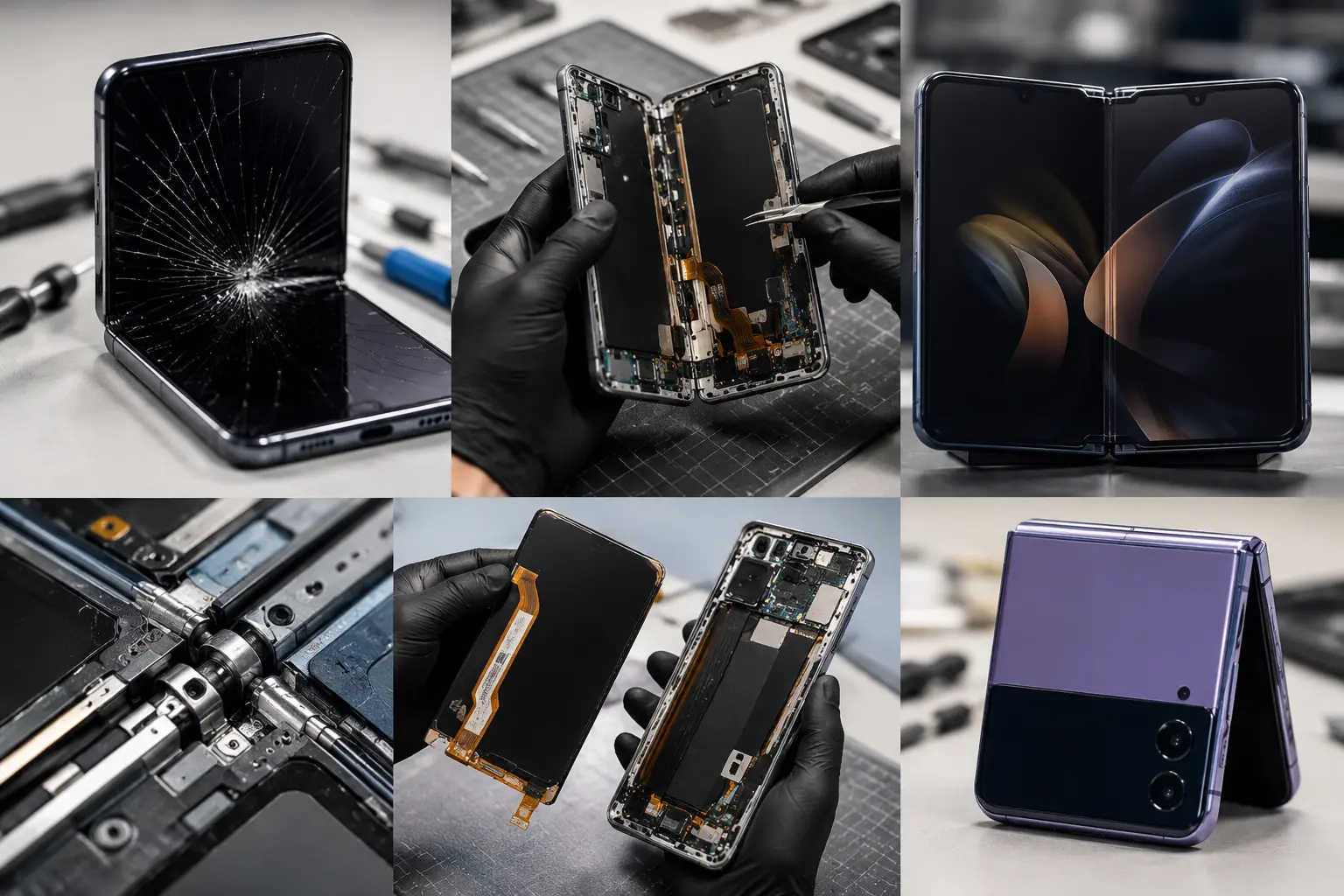
Foldable Screens Are Repairable (But Not Simple)
Samsung's Galaxy Z Flip and Z Fold series use a flexible Ultra Thin Glass (UTG) display that bends along a central hinge. When that display cracks, develops a crease line, or stops responding to touch along the fold, most people assume the phone is done. It's not. Foldable screens are repairable, but the repair is more involved than a standard slab phone.
How Foldable Displays Differ From Standard Screens
A traditional phone screen is a rigid glass panel bonded to an OLED or LCD layer. A foldable screen replaces that rigid glass with a thin, flexible polymer-coated glass that can bend repeatedly along the hinge axis.This flexibility makes the display more vulnerable to certain types of damage. Pressure on the fold line can crack the UTG layer. Debris (sand, crumbs, grit) that gets between the two halves when the phone closes can puncture the screen from the inside. Temperature extremes can cause the adhesive layers to separate, creating visible bubbles or delamination along the crease.The hinge mechanism itself is also a wear component. Over thousands of open/close cycles, the hinge can develop play, stop holding at certain angles, or make grinding sounds.
Common Foldable Phone Issues
Cracked or dead pixels along the fold line is the most common failure. The display cracks where it bends, usually from a drop or from closing the phone on a small particle trapped inside.
Screen delamination or bubbling happens when the layered structure of the flexible display separates, especially in humid conditions or after prolonged exposure to heat. This shows up as a visible bubble or wrinkle that doesn't go away.
Unresponsive touch along the crease means the touch digitizer layer has failed at the fold point even if the display looks fine visually. You'll notice a horizontal dead zone across the middle of the screen.
Hinge stiffness or looseness means the hinge won't stay open at a specific angle, feels gritty when opening, or flops open too easily.
Outer cover screen damage applies to both the Z Flip and Z Fold. The smaller outer display uses standard glass and can be replaced independently from the inner foldable display, usually at a much lower cost.
What a Foldable Screen Repair Involves
Replacing the inner foldable display requires disassembling the phone from a specific sequence (typically starting from the back panels), carefully detaching the flexible display from the frame and hinge assembly, installing the new display, and recalibrating the fold angle so the screen sits properly when closed.
The replacement display must be specifically designed for that exact model and generation. A Z Flip 4 screen is not interchangeable with a Z Flip 5. The fold radius, connector placement, and adhesive pattern differ between generations.
Because of the complexity, foldable screen repairs take longer than standard screen replacements (typically 1 to 2 hours) and the part itself costs more than a standard slab phone screen.
Should You Use a Screen Protector on a Foldable?
Samsung ships every Z Flip and Z Fold with a pre-installed screen protector on the inner display. Do not remove it. Unlike standard phones where the protector is optional, this protector is part of the display assembly on foldables. Removing it can damage the UTG layer underneath.
If the protector peels, bubbles, or gets scratched, it should be replaced, but with a protector specifically designed for foldable screens. Standard tempered glass protectors are too rigid and will crack at the fold.
Foldable Repairs at Our Shop
We repair Galaxy Z Flip and Z Fold screens at our Albuquerque Samsung repair location. Both inner foldable displays and outer cover screens are replaced in-house. We also handle hinge repairs and battery replacements on foldable models.
If you're not sure whether the damage is on the inner screen, outer screen, or the protector layer, bring it in for a free diagnostic. We'll tell you exactly what needs replacing before starting any work.